
An Exploration of Lesbian Representation in Classical Mythology
Girl cows don’t love girl cows, and girl horses don’t love girl horses.1
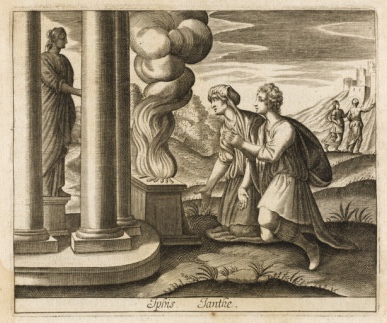
Classical myths from Ancient Greece and Rome are rich with LGBTQIA themes that offer profound insights into the prevailing ideas on sexuality within those cultures. It’s striking to note that while the celebration and prevalence of male love are evident in the retellings of characters like Achilles and Patroclus, as well as the numerous male lovers of Apollo, there is a noticeable absence of female sexuality and love.
The question here, then, is why?
When investigating this, I came to the conclusion that – in a very general sense – this glaring gap in representation stems from an ancient belief that it was highly improbably for a woman to love another woman (of course it should be noted that this belief is not entirely extinct. While the physicality of lesbian relations are often eroticized, this fetishization removes the identity and emotion that exists behind the physical love. In other words, by focusing purely on the physical relations, and how it appeals to a male gaze, it removes the love. It removes the women).
In this dive to find the ‘missing lesbian,’ we’ll be exploring sexual expression and suppression in classical mythology and cultures, with a specific focus on ancient Greece and Rome.
Achilles, Apollo, and Male Queer Sexuality
Achilles and Patroclus.
If you follow along with current book trends, particularly those trends that are popular on TikTok, you have heard of that dynamic duo.
When LGBTQ+ themes are discussed within the context of classical mythology, it is hard to get more than five minutes into the discussion without Achilles and Patroclus being brought up. This is for a good reason, while the Iliad – written by Homer – had no explicit mentions of there being a romantic relationship between the two, modern retellings and understandings have delved deeper into the intimate relationship between the two men.
One particularly popular retelling, The Song of Achilles, is a modern novel written by Madeline Miller in 2011, adapted from Homer’s Iliad. The story is told from the point of view of Patroclus as he meets Achilles and they journey to fight in the Trojan War. While this modern adaptation has its roots in Homer’s original story, The Song of Achilles has a primary focus on the romantic relationship between the two – one that is distinctly different than the platonic relationship they had within Homer’s version.
Within the Homeric tale, Achilles was reared by his mother at Phthia with his companion and friend Patroclus. And it wasn’t until much, much later that non-Homeric tales suggest that Patroclus was Achilles’ lover2. Despite these interpretations occurring far after the original Homeric telling, the idea that there might have been a romantic connection between these two is not extremely far-fetched.
Within ancient Greece and Greek myths, male love was not just common but often celebrated. According to a blog-post written in 2018, “male homosexuality in antiquity was widely accepted… There was the value of man’s overall dominance and a celebration of their sexuality.”3 This sexual and masculine dominance manifested in numerous forms, whether in sexual relations with women, young boys, or enslaved people. Because of its prevalence in Greek culture, it is only to be expected that it would be represented in the myths that helped shape that culture’s understanding and interactions with their world. Because, above all, myths are how cultures interacted and made sense of a very confusing, and rapidly changing world.
(For the sake of the length of this post, to find more about Apollo and his sexual representation in mythology, I would recommend beginning your research with his relationship with Hyacinth.)
The Missing Lesbian
So, we have a basic understanding of male sexuality and how it relates to mythology. One would expect there to be something, anything, relating to sapphic relations. But there is a stark contrast between the representation of male queer relationships and female queer relationships – namely, there simply aren’t very many stories about lesbians.
When digging through sources for this blog post, I struggled to find clear reasonings for this. The most popular one that I found is that lesbianism was simply found unnatural in ancient Greek society.
The question, again, is why. If gay love is so celebrated, why then should lesbian love not be given the same treatment?
According to a few different sources but summed up well by a previously mentioned blog post, the act of sex in Greek society “required penetration” and this belief resulted in an “inability to comprehend female sexuality,” in particular, lesbianism.
The term lesbian did not even explicitly mean what we now understand the term to mean in modern times. It is a demonym of Lesbos, the island where ancient Greek poet Sappho was born. Sapphic, then, another term for female queer relations, is also derived from the Greek poet Sappho.
Very little remains of Sappho’s poetry, however, she has been heralded as one of the best poets of her time. While her sexuality is still debated – we cannot be fully certain that her use of “I” in homoerotic poems is autobiographical – many in modern, and ancient times believe that she did have homosexual encounters and wrote those into her poetry.
For the sake of this post and in my own humble opinion upon reading through what remains of Sappho’s poetry, I will be classifying Sappho as having had queer relationships and centering those relationships in her poetry.
Here I insert Fragment 31, my favorite fragment written by Sappho, and one of her most well known surviving poems. For added context, this fragment has three characters: a man, a woman, and the speaker. The speaker, we can assume, is Sappho herself.
Sappho, Fragment 31

That man seems to me to be equal to the gods
who is sitting opposite you
and hears you nearby
speaking sweetly

and laughing delightfully, which indeed
makes my heart flutter in my breast;
for when I look at you even for a short time,
it is no longer possible for me to speak

but it is as if my tongue is broken
and immediately a subtle fire has run over my skin,
I cannot see anything with my eyes,
and my ears are buzzing

a cold sweat comes over me, trembling
seizes me all over, I am paler
than grass, and I seem nearly
to have died.

but everything must be dared/endured, since–
The meaning of this poem has been the subject of much scholarly debate, is it about Sappho’s jealousy of the man? Is it about Sappho’s amazement that the man can retain his composure so close to the object of her own desire? ( I myself find myself leaning towards the latter).
Fragment 31, across all translations, has a abrupt, cut off ending. One that has been lost. I agree, then, with a quote from Susan Gubar’s Sapphistries that “Sappho represents… all the lost women in literary history, especially all the lesbian artists whose work has been destroyed, sanitized or heterosexualized.”4
Moving away from Sappho for a moment and back towards classic mythology, there is only one story in all of ancient Greek and Roman mythology that I could find that had female same-sex desire. And that is the story of Iphis and Ianthe from Ovid’s Metamorphoses.
Metamorphoses is an ancient poem that tells the story of a child named Iphis who was born as a girl but raised as a boy under the goddess Isis’ command. When Iphis turned 13, they were engaged to Ianthe with whom they fell deeply in love. Despite Iphis’ love towards Ianthe, Iphis felt that their desires were unnatural (look to the quote at the beginning of this post for a translation that really emphasizes this belief). Iphis desired to change their sex from female to male, and in the end, this wish was granted and Iphis and Ianthe were wedded to live ‘happily ever after’. While this is a story of female same sex attraction, it also dabbles heavily into gender dysphoria and transgenderism – something which is also not often represented in the classics.
Christine Downing delves deeper into the story of Iphis and Ianthe in her paper, Lesbian Mythologies. She states that while Ovid might believe that this story ends happily, from her perspective “it reveals how without stories, without models, a woman’s discovery that she loves another woman may be bewildering and frightening”5 and I can’t help but agree.
I think it’s important to say that I absolutely do not want to minimize the gender aspect of this poem, however, for the sake of this post, I want to focus on the sexual identity of Iphis.
Downing goes on to say that “[Iphis] cannot imagine how such a love might be lived out except by her becoming a man.” This goes back to an idea touched on earlier that in ancient Greece, sex was impossible for women to have with other women, because there would be no act of penetration. In a queer female relationship, there would be no ‘natural’ penetration, therefore there is no natural way for two females to have an experience of physical love.
The story of Iphis and Ianthe can be viewed as tragic as much as it can be viewed as having a happy ending. Iphis feels that they have no other choice but to change her entire identity to be with who they love. Iphis grapples with her gender not because she longs to become a man, but because she longs to have an acceptable love. Moreover, there are definitely cultural elements that play into the fact that it is the only representation of female same-sex love in Greek myth and this female same-sex love is flipped on its head by the end.
Final Thoughts
Throughout all of my research into the myths and cultures of the ancient Greeks and Romans, I truly was expecting there to be more representation of female sexuality, specifically same-sex female sexuality.
That just wasn’t the case.
The cultures in the times that these myths were first circulated is almost certainly the reason for that. I think that even in today’s culture, though there have been so many improvements in the acceptance and representation of queer individuals, there is still so far to go.
Downing brought up a great point in her article that I believe can be applied far beyond the concept of lesbianism, and that is that without representation of marginalized groups, those marginalized groups can be repulsed and horrified with themselves when they experience things that the rest of a society doesn’t experience.
LGBTQIA people exist now just as they existed in the past. The only difference is how they are accepted and represented in the stories that are shaped by their societies.
Representation is more than just important. It is vital.
- Met. IX.726–734; https://eidolon.pub/life-as-an-iphis-fbdecf92fbe1 ↩︎
- Britannica, The Editors of Encyclopaedia. “Achilles”. Encyclopedia Britannica, 30 Nov. 2022, https://www.britannica.com/topic/Achilles-Greek-mythology. Accessed 26 April 2023. ↩︎
- Mcwildeboer, and Cyrus. “Lesbianism and Queer Female Sexuality in Ancient Greece.” Women in Antiquity, 27 Nov. 2018, https://womeninantiquity.wordpress.com/2018/11/27/lesbianism-and-queer-female-sexuality-in-ancient-greece/. ↩︎
- Gubar, Susan. “Sapphistries.” Signs, vol. 10, no. 1, 1984, pp. 43–62. JSTOR, http://www.jstor.org/stable/3174236. Accessed 26 Apr. 2023. ↩︎
- Downing, Christine. “Lesbian Mythology.” Historical Reflections / Réflexions Historiques, vol. 20, no. 2, 1994, pp. 169–99. JSTOR, http://www.jstor.org/stable/41298993. Accessed 26 Apr. 2023. ↩︎
 Something Clever