
The Memories That Haunt Within Guillermo del Toro’s The Devil’s Backbone (2001)
*This analysis contains spoilers of The Devils Backbone (2001)*
Que es un Fantasma?
What is a ghost?
The voice-over asks as us this as the shot fades in from black. There is a haunting whisper of noise while the camera zooms closer to an arched doorway shrouded in darkness.
As we get pulled into this dark, a bomb drops from the belly of a warplane onto the world already wrecked with explosion after explosion down below. Rain pours relentlessly, bombs explode against the earth, and a young boy lies in a puddle of blood in the underbelly of his orphanage.
We see the boy, Santi, dying against the stone-cold ground, as another boy, later revealed to be Jaime, cradles Santi’s head while the soft beginnings of a thematic high-pitched squeal plays in the background.
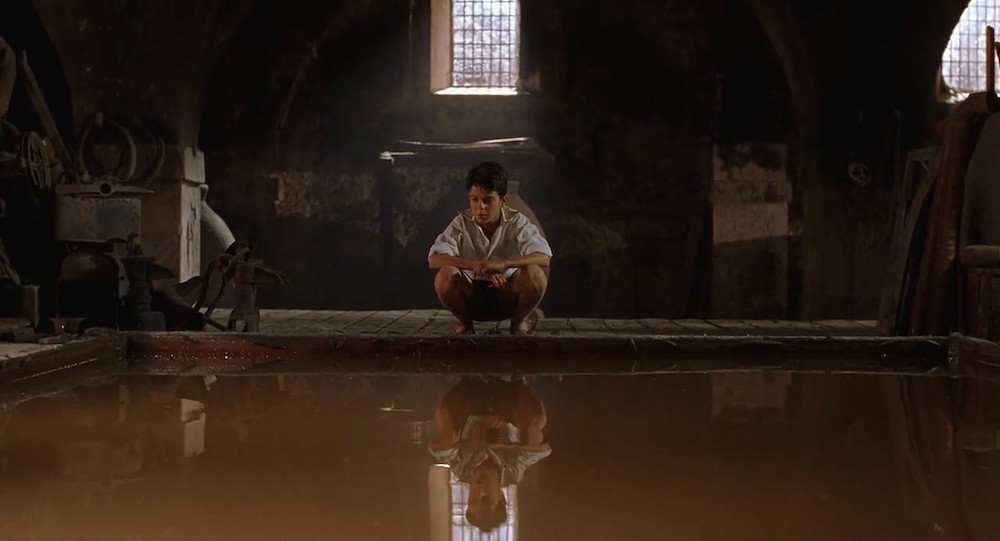
In the final moments of the opening segment of Guillermo del Toro’s El espinaz odel diablo (The Devil’s Backbone) (2001), Santi falls into the depths of murky water, blood swirling up around his head while the sound rushes all around ours as we sink deeper with him.
This opening sequence begins its end when the dead child becomes trapped in the depths of the water, while Jaime crouches horrified and in tears on the lip of the cistern.
“Un sentimiento suspendido en el tiempo, como una fotografia borrosa, como un insecto atrapado en ámbar.”
(A feeling suspended in time, like a blurred photograph, like an insect trapped in amber).
The voice-over continues as each shot dissolves into the next. Murky water morphs into more murky water through a series of digital dissolves that link each shot together. While the objects floating in the amber-colored liquid are initially unidentifiable, as the credit sequence begins, it is soon revealed that these floating objects are fetuses. All with their spines exposed.
The Devil’s Backbone.
Guillermo del Toro’s The Devil’s Backbone starts with a sequence that the film shows again later as a flashback, and the narration comes back at the end with new shots. All five shots in this initial segment connect Dr. Casares’ voice-over exploring the meaning of a phantom, or ghost.
While some aspects play out in a very linear fashion, the film repeats, revives, and rewrites this segment into the narrative several times over. Each time the shots unfold on the screen before us, the meaning revises with this repetition and the viewer is presented with more context and therefore a deeper understanding of this ‘moment-before’ that the opening segment intentionally leaves ambiguous.
The narration, repeated once more at the end, unites the entire story across past and present.
These first five shots connect Dr. Casares’ voice-over about a ghost. The film revisits this segment multiple times, adding more context and understanding each time. When the narration is repeated at the end, it ties the whole story together from past to present.
Exposition
The Devil’s Backbone is a film set during the Spanish civil war and exists as a spiritual prequel and sister film to Pan’s Labyrinth (2006), another one of del Toro’s works.
While the beginning of the film is intentionally left ambiguous through an opening sequence as murky as the cistern water we sink in, the rest of the film has a fairly straightforward plot.
Carlos, the protagonist, is a boy orphaned by war and sent to live at an all-boys orphanage. He has his first interaction with a ghost on his first day, and through a series of haunting encounters and trials and tribulations with an older boy, Jaime, it is revealed to Carlos that the ghost is a murdered boy named Santi whose death preceeded Carlos’ arrival at the orphanage. His death, witnessed by Jaime, is what played during the opening segment of the film.
Later, it is revealed that Santi was murdered by Jacinto, an agressive man who works at the orphanage and is driven by a violent greed. On the night that Santi was murdered, Jacinto was accidentally caught attempting to steal. The opening sequence specifically offers the non-tangible experience of trauma and pain, a visual representation on screen through the blunt and agonizing murder of a young child.
During this opening segment, Carlos is not even a character that has been introduced. All we see is the direct aftermath of a traumatic event. A deadly event. Later in the film when this sequence is revisited by Jaime telling the evennts of that night to Carlos, the shots expand the narrative we have come to know. The viewer gets an ‘ah-ha’ moment.
Santi was murdered. His head cracked against brick with a bright flash of white. As the narrative unravels and rewrites on screen before their very eyes we learn that Jacinto – a character that finds his drive through a greed that will inevitably bring about endless amounts of destruction – is the one who killed him, albeit accidentally.
(I think an interesting thing to note is that greed is often what brings about the donwfall of villains across genre and time. It is one the seven deadly sins afterall. Often before it hurts the sinner, Jacinto, it hurts the innocent, Santi.)
What Haunts Us: Trauma
Trauma is a non-visible experience. It is a feeling. Something that is suffered. It isn’t often given a physical manifestation.
Within The Devil’s Backbone, trauma takes physical form. Or, as physical a form as a ghost can be.
Janet Harbord writes that “a ghost story is always poised on the paranoid edge of dis/belief… The ghostly brings an anxiety simply by its presence, which is always and only a half-presence, an ‘appearance’ of an Other that cannot fully emerge because the ghost is always by definition out of place.”1
The experience for Carlos is initially, and understandably, entirely foreboding and terrifying, especially when you consider that we expereince the world as he does, i.e. through the eyes of a child.
Santi is a memory of a boy sunk deep in the water.
While he appears tangible on screen and though he leads Carlos to believe he is truly taking up physical space in our realm, we know that he is not. He is a ‘half-presence’ that is out of place. He is a memory of a boy that once was alive, as Harbord writes, he is a “trace of traces among traces.”
Santi is sinister in appearance despite the child’s rather pure intention of alerting to the orphanages impending disaster.
He is pale with white eyes, blood eternally floating up from the everlasting wound on his head and he is always accompanied by a high-pitched squeal that resembles the sound of his last whined out breath. His ghostly presence alone, as well as his unsettling appearance, brings an anxiety to the screen that is only aided by the squeal that follows the ghost boy wherever he wanders.
However, as Carlos further interacts with this ghost, first listening to his voice, and then physically interacting with the boy later, he comes closer to the root of the trauma that has forced Santi to stay. What has made him become a ghastly memory of who he was before. All of this reflects within this opening sequence.
Santi’s ghost is ever-present in the film. I’m reminded of a quote that has no real origin: “a ghost in every frame.”
Truthfully, I found myself analyzing every shot. I saught glimpses of the pale, ghostly Santi looming over the shoulder of Carlos. Within the opening sequence, and later when it screens again via flashback, we see a lively young boy turn into a memory of himself.
A ghost.
Moreover, this idea of a ‘ghost’ finds a home in the work of Apichatpong Weerasethakul’s Uncle Boonmee Who Can Recall His Past Lives (2010). Within Uncle Boonmee, Boonmee is a man who is dying. He is very aware of his death and throughout the film, he is joined by his deceased wife, his living family, and his long-lost son who has turned into a supernatural Monkey Ghost. (No really, a Monkey Ghost. I cannot recommend this film highly enough.)
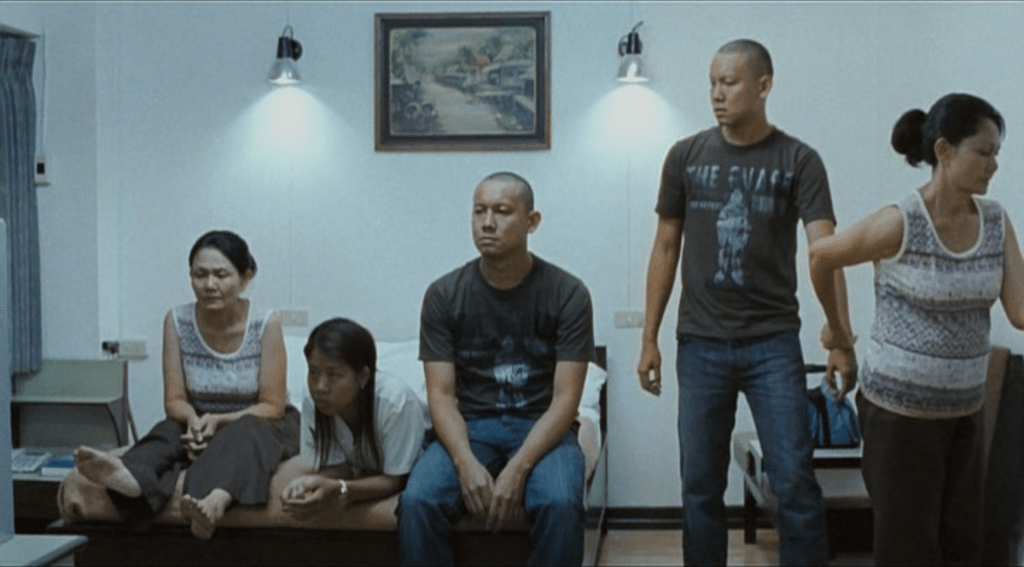
Specifically, the part that I am drawn to for comparison is the last shot of Uncle Boonme. As Jen sits with Tong (both characters who were with Boonmee prior to his death) and Jen’s friend Roong, the three set out to leave the room. As they do, Tong turns back and sees versions of themselves still sitting on the bed they just stood up from.
Are ghosts memories?
Are they impressions left on the world that they leave behind? Like a handprint in memory foam?
Or are they perhaps temporal or spatial shifts? Existing now as they always have?
Regardless, the theme of ghosts and their interactions with the world they never left is ever-present within both films.
Further quoting what Harbord has written in ‘Hauntology and Hospitality’, “haunting takes the form not only of temporal shifting but spatial disjunction as though the present can multiply and reproduce states that co-exist.”
A haunting doesn’t always need a physical ghost, despite there being physical ghosts in both of the aforementioned works. All a ghost is is a ‘tangible’ representation of the past, of a memory, or a trauma.
A ghost, and the subsequent haunting, seeks to reconnect in some way with the past. This is a theme that is not only present in Weerasethakul’s work but also in del Toro’s repertoire.
Tying this all back to the opening sequence, and accompanying voice-over, the narration asks “Que es un Fantasma?” What is a ghost? To del Toro and Weerasethakul alike, that answer seems to be in the same vein.
The humanity that lives on after the physical body dies.
It is a memory.
In Conclusion
The stunning opening sequence of The Devil’s Backbone goes through several revisions within the film. Each time we revisit the shots, or the voice-over repeats, another detail adds on to an already rich moment.
The ‘horror’ of this movie is quiet in the same way that a memory or a phantom is quiet. The Devil’s Backbone is as much a ghost film as it is a film that deals with the trauma of the past and of war.
(In this post, I really only focused on the quiet trauma of the piece, but there is much to be said about the cultural and wartime influences on this movie.)
Much like Uncle Boonmee, it is as painfully beautiful as it is unnerving. The repetition of the opening segment through various visual and audial moments seeks to infuse the past with the present.
We see the ghost of Santi appearing to Carlos on many occasions in many placesm each time as horrifying as the last. We hear the tell-tale high-pitched squeal that accompanies Santi’s ghost. When there are ghosts, the past and the present co-exist and with the presence of a haunting, there is a manifestation of the non-tangible (memory, trauma, grief, etc.) becoming tangible.
When I sought to come up with what kind of sequence this opening segment is, I found myself torn. Mostly because the audio repeats later on with different shots, and this opening sequence is flashed back to during the film.
The sequence makes temporal leaps while managing to ground itself spacially. The film rewrites the idea of a flashback, with the sequences playing with David Bordwell’s definition of a flashback. It is neither solely internal nor external, but both.
I decided to label this sequence as one that plays with the aspects of both an ordinary sequence and an episodic sequence. If only this first iteration of the shots are looked at, then it is straightforward, linear, with slight jumps in space and time. When looking at the entire film, episodic seems to fit just as well as the ordinary sequence does.
Regardless, the spatial and temporal ellipses that define this segment is also what defines the thematic messaging of del Toro’s work – that memory and trauma are always changing, and ever-present.

- Harbord, J. (2017). Hauntology and Hospitality in the Films of Apichatpong Weerasethakul. In Z. Feldman (Eds.). Art and the Politics of Visibility: Contesting the Global, Local and the In-Between (pp. 167–188). London•New York: I.B. Tauris. ↩︎
 Something Clever